A werewolf was a human who suffered from lycanthropy, an infection that caused them to transform into lupine creatures, particularly during full-moon nights.[1]
Origins
- “It acts on pure instinct. No conscience, predatory and aggressive.”
- ―Rupert Giles[src]
A person would become a werewolf after another werewolf bit them,[1][2] which infected their blood with werewolf saliva.,[3] It did not matter whether the original werewolf was transformed or not at the moment the bite took place.[1] Scratches did not change a person,[3][4] nor was the condition genetically passed to offspring.[5]
After the infection, the victim transformed into a lupine creature during the three nights of the full moon and remained so from sunset to sunrise,[1] or, in the case of the Lycanthropus exterus breed, from moonrise to moonset.[6] If the infection occurred during a night of the full moon, the newly bitten werewolf would only be able to transform on the next full moon night.[6] When transformed, the human side of the psyche was completely dormant, taken over by a feral predatory mentality that knew only the hunt.[1]
Biology
Werewolves were capable of sensing strong emotions, sometimes from miles away, and were attracted by sexual heat.[1] The werewolf's sense of smell was highly developed and remained so even when in human form.[7] It was enhanced enough to track and distinguish the scents of individual people,[7][8] and enabled the werewolf to smell whether someone was afraid.[7] Nina Ash showed increased sight and hearing as well, and craved meat.[6] Werewolves could perceive the presence of other werewolves[9] and had a primal, physical attraction to one another.[10]
The psyche of a newly bitten werewolf remained separate between the human self and the feral side. The werewolf did not remember their transformation until evidence provided conscious knowledge of their condition, such as waking up naked in a place different from where they had transformed.[1][6]
Even after the werewolf acknowledged its condition, they retained no memories of whatever action they might have taken during the transformation.[10] The lupine beast, completely dominated by instinct, was incapable of recognizing loved ones or friends.[1][8][10][11][12][13] It did, however, retain some of the person's intelligence, being able to recognize certain words and react to them, often violently.[11] The wolf side also influenced the werewolf's basic instincts and impulses while in human form.[6][10]
As the time a person had been a werewolf lengthened, they would begin to retain memories of the time spent in wolf form.[10] Before this phase of the werewolf's life, it was also possible for the werewolf to exert certain influence on its actions during the feral phase.[10]
Silver was the most effective way to kill a werewolf,[6] but other severe injuries were enough to be fatal as well. While both were transformed, Daniel "Oz" Osbourne killed Veruca by tearing into her throat with his fangs.[8] During the battle against Twilight's army, members of Monroe's pack lay dead with (regular) bullet wounds riddling their chests.[14]
Like vampires, werewolves could be affected by drugs (such as Haldol)[8] and tranquilizers (such as Phenobarbital).[1] A tranquilizer meant for a transformed werewolf was once accidentally used on a regular human without any lasting ill effect,[11] so whatever the dosage was, it wasn't lethal to humans. Tranquilizers were sometimes employed to restrain free-roaming werewolves without injuring them.[1][6]
Cures
The werewolf curse was impossible to cure as a whole: once a person became infected, they could not be unmade a werewolf. However, it was possible to control the transformation. During his first visit to Tibet, Buddhist monks taught Oz meditation techniques combined with herbs in his diet, chanting, and charms. After this, he was able to roam about under a full moon in apparent ease and comfort. However, with this technique, intense negative stimulation such as great physical pain or overly stressful social situations could trigger the transformation, even during the day.[8]
Returning to Tibet for a second time, Oz and Bayarmaa found a more wholesome way to control their werewolf transformation, based on the original Tibetan religion, Bon. This time, rather than bottling up the wolf, they allowed its energy to flow out of them and into the world around them: "the wolf is pulled into the earth." This technique took about a year to get right and consisted, among other things, of connecting with the land with their own mortal bodies.[5] However, the method's necessary chants were actually an invocation of wrathful goddesses dwelling deep inside the earth, who accepted the werewolves' offering of their power in exchange for the deities' protection.[14]
Psychological and social issues
While some werewolves tried to hold their animalistic impulses in check,[1][13] other werewolves believed that their human side was merely a disguise, a cage for their true selves, and they did not restrain themselves in any way.[10][5] Whether a werewolf chose to embrace its condition or not depended on several social and psychological factors and couldn't be blamed solely on the influence from the bestial side of the werewolf psyche:
- Both Oz and Nina, after they learned of their condition, sought out ways of restraining themselves during their transformations to protect people, especially their loved ones.[1][13]
- Veruca, unlike Oz, relished her werewolf condition, believing it to be her true self. She refused to be locked up during her transformation and let her instincts and impulses dominate every one of her actions, whether in human or in lupine form. She believed that doing what comes naturally is good and desirable, even if these impulses included killing.[10]
- McManus originally tried to protect people from himself. He abandoned his family and tried to remain away from people. Eventually, he gave up and returned to populated areas. Unlike Oz or Nina, he lacked the necessary support to cling to his humanity.[6]
- Monroe originally went to Oz's Tibetan monastery to be cured, suffering terribly from his condition. However, after returning to the world, Monroe got tempted and no longer followed Oz and Bayarmaa's teachings properly. He soon held beliefs similar to Veruca's and became the leader of a group of werewolves who shared his views, believing that the wolf side was the best part of them.[5]
- Other werewolf packs seemingly held similar beliefs to Veruca's and sometimes kidnapped young werewolves to increase their ranks.[6]
On the side of humans, reaction to the existence of werewolves was varied:
- Gib Cain hunted down werewolves in lupine form to skin them and sell their fur in Sri-Lanka. He didn't care that his victims were humans for the rest of the month.[1]
- The Scooby Gang and the Angel Investigations team argued that werewolves couldn't be held accountable for their actions in lupine form.[1][6] They did make an exception to this belief when it came to werewolves who, knowing of their condition, did not seek any method of restraint, regarding these individuals as they would have regarded common vampires and demons, or at least dangerous humans.
- Certain parties and individuals held werewolves as abominations and sought to eliminate them.[6]
- Paranormal sporting groups captured werewolves to hunt them down in events or used them like hunt dogs for vampire hunting, similar to fox hunting in England.[6]
- Werewolf flesh was considered a delicacy in certain circles. They captured werewolves, cleaned, restrained, and served them alive, as the particular sub-species of werewolf coveted for its meat, Lycanthropus exterus, would revert to human form after dying.[6]
- After catching a werewolf, doctors and researchers of the Initiative regarded and treated it the same as they would a common demon: they experimented on and researched it freely, not hindered when it turned back into a human being and learned that said person was actually a student at the above UC Sunnydale. The human was eventually locked naked into one of their cells, no different than any other demons they had obtained. This event forced Riley Finn to realize the full extent of the Initiative's corruption and caused him to leave the group.[8]
- Plausibly based on a real person's memories, the cyborg of Roger Wyndam-Pryce declared that the Watchers Council had fought werewolves in the past.[15]
Species
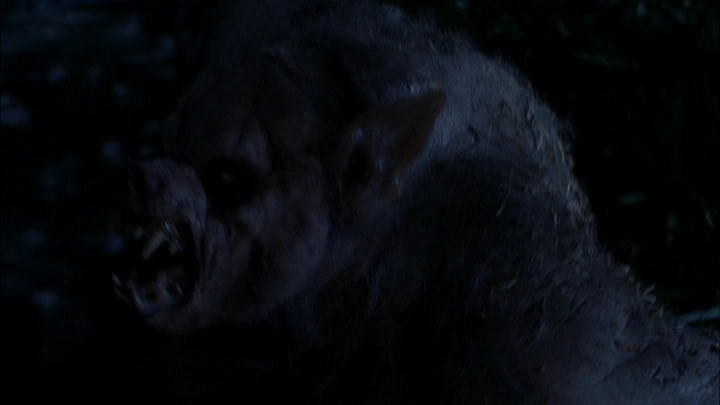

A Lycanthropus exterus.
There were more than one species of werewolf. Nina Ash contracted lycanthropy from a breed of werewolf never seen before in North America called Lycanthropus exterus. Thus, Nina was a different species of werewolf from Oz and Veruca's.[6]
The more common werewolf was smaller, with a heavy coat of fur, and while still very dangerous, didn't have a large mouth or canine set of teeth. The Lycanthropus exterus, in contrast, walked on two legs, had longer, more powerful arms, was larger, and sported a more canine-like head and fangs.[6]
Examples
Behind the scenes
- Oz's appearance in his werewolf transformation has altered through the years. In his first appearance ("Phases"), he's depicted as a wolf-headed hairy humanoid and walks on two legs; in all other episodes ("Beauty and the Beasts," "The Zeppo," "Wild at Heart," and "New Moon Rising"), he's more ape-like in appearance, walks on four legs, and sports a more humanoid face. In Season Eight (Retreat, Part Two, Retreat, Part Four, Retreat, Part Five), werewolves are again shown with a wolf-like muzzle, depicted as standing and walking on two legs and running on four. The alternative canon series Angel + Spike (#14, #15, #16) and Angel (#6, #7, #8) portray werewolves as bipedal wolves much larger than humans.


Appearances
Canonical
| Buffy the Vampire Slayer: Season 1 | |||||||||||
| "Welcome to the Hellmouth" Mention |
"The Harvest" Absent |
"Witch" Absent |
"Teacher's Pet" Absent |
"Never Kill a Boy on the First Date" Absent |
"The Pack" Absent |
"Angel" Absent |
"I Robot, You Jane" Absent |
"The Puppet Show" Absent |
"Nightmares" Absent |
"Out of Mind, Out of Sight" Absent |
"Prophecy Girl" Absent |
| Buffy the Vampire Slayer: Season 2 | |||||||||||
| "When She Was Bad" Absent |
"Some Assembly Required" Absent |
"School Hard" Absent |
"Inca Mummy Girl" Appears |
"Reptile Boy" Absent |
"Halloween" Appears |
"Lie to Me" Absent |
"The Dark Age" Absent |
"What's My Line? Part One" Appears |
"What's My Line? Part Two" Appears |
"Ted" Absent | |
| "Bad Eggs" Absent |
"Surprise" Appears |
"Innocence" Appears |
"Phases" Appears |
"Bewitched, Bothered and Bewildered" Appears |
"Passion" Absent |
"Killed by Death" Absent |
"I Only Have Eyes for You" Absent |
"Go Fish" Absent |
"Becoming, Part One" Appears |
"Becoming, Part Two" Appears | |
| Buffy the Vampire Slayer: Season 3 | |||||||||||
| "Anne" Appears |
"Dead Man's Party" Appears |
"Faith, Hope & Trick" Appears |
"Beauty and the Beasts" Appears |
"Homecoming" Appears |
"Band Candy" Appears |
"Revelations" Appears |
"Lovers Walk" Appears |
"The Wish" Appears |
"Amends" Appears |
"Gingerbread" Appears | |
| "Helpless" Appears |
"The Zeppo" Appears |
"Bad Girls" Appears |
"Consequences" Absent |
"Doppelgängland" Appears |
"Enemies" Appears |
"Earshot" Appears |
"Choices" Appears |
"The Prom" Appears |
"Graduation Day, Part One" Appears |
"Graduation Day, Part Two" Appears | |
| Buffy the Vampire Slayer: Season 4 | |||||||||||
| "The Freshman" Appears |
"Living Conditions" Appears |
"The Harsh Light of Day" Appears |
"Fear, Itself" Appears |
"Beer Bad" Appears |
"Wild at Heart" Appears |
"The Initiative" Mention |
"Pangs" Absent |
"Something Blue" Mention |
"Hush" Absent |
"Doomed" Mention | |
| "A New Man" Absent |
"The I in Team" Absent |
"Goodbye Iowa" Absent |
"This Year's Girl" Absent |
"Who Are You?" Mention |
"Superstar" Absent |
"Where the Wild Things Are" Absent |
"New Moon Rising" Appears |
"The Yoko Factor" Absent |
"Primeval" Absent |
"Restless" Vision | |
| Angel: Season 1 | |||||||||||
| "City Of" Absent |
"Lonely Heart" Absent |
"In the Dark" Appears |
"I Fall to Pieces" Absent |
"Rm w/a Vu" Absent |
"Sense & Sensitivity" Absent |
"The Bachelor Party" Absent |
"I Will Remember You" Absent |
"Hero" Absent |
"Parting Gifts" Absent |
"Somnambulist" Absent | |
| "Expecting" Absent |
"She" Absent |
"I've Got You Under My Skin" Absent |
"The Prodigal" Absent |
"The Ring" Absent |
"Eternity" Absent |
"Five by Five" Absent |
"Sanctuary" Absent |
"War Zone" Absent |
"Blind Date" Absent |
"To Shanshu in L.A." Absent | |
| Buffy the Vampire Slayer: Season 5 | |||||||||||
| "Buffy vs. Dracula" Absent |
"Real Me" Absent |
"The Replacement" Absent |
"Out of My Mind" Absent |
"No Place Like Home" Absent |
"Family" Absent |
"Fool for Love" Absent |
"Shadow" Absent |
"Listening to Fear" Absent |
"Into the Woods" Absent |
"Triangle" Absent | |
| "Checkpoint" Absent |
"Blood Ties" Absent |
"Crush" Absent |
"I Was Made to Love You" Mention |
"The Body" Absent |
"Forever" Absent |
"Intervention" Absent |
"Tough Love" Absent |
"Spiral" Absent |
"The Weight of the World" Absent |
"The Gift" Absent | |
| Buffy the Vampire Slayer: Season 7 | |||||||||||
| "Lessons" Mention |
"Beneath You" Absent |
"Same Time, Same Place" Absent |
"Help" Absent |
"Selfless" Absent |
"Him" Absent |
"Conversations with Dead People" Absent |
"Sleeper" Absent |
"Never Leave Me" Absent |
"Bring on the Night" Absent |
"Showtime" Absent | |
| "Potential" Mention |
"The Killer in Me" Absent |
"First Date" Absent |
"Get It Done" Absent |
"Storyteller" Absent |
"Lies My Parents Told Me" Absent |
"Dirty Girls" Absent |
"Empty Places" Absent |
"Touched" Absent |
"End of Days" Absent |
"Chosen" Absent | |
| Angel: Season 5 | |||||||||||
| "Conviction" Absent |
"Just Rewards" Absent |
"Unleashed" Appears |
"Hell Bound" Absent |
"Life of the Party" Absent |
"The Cautionary Tale of Numero Cinco" Absent |
"Lineage" Mention |
"Destiny" Absent |
"Harm's Way" Absent |
"Soul Purpose" Absent |
"Damage" Absent | |
| "You're Welcome" Absent |
"Why We Fight" Absent |
"Smile Time" Appears |
"A Hole in the World" Absent |
"Shells" Absent |
"Underneath" Absent |
"Origin" Absent |
"Time Bomb" Absent |
"The Girl in Question" Mention |
"Power Play" Appears |
"Not Fade Away" Absent | |
| Spike | |||||||||||
| Asylum, Part 1 Absent |
Asylum, Part 2 Appears |
Asylum, Part 3 Appears |
Asylum, Part 4 Appears |
Asylum, Part 5 Appears |
Spike: After the Fall, Part 1 Mention |
Spike: After the Fall, Part 2 Absent |
Spike: After the Fall, Part 3 Absent |
Spike: After the Fall, Part 4 Mention | |||
| Alone Together Now Mention |
What Happens in Vegas, Slays in Vegas Absent |
Everybody Loves Spike Absent |
You Haven't Changed a Bit Absent |
Bedknobs and Boomsticks Absent |
Something Borrowed Absent |
Give and Take Absent |
Stranger Things Appears |
Spike: Into the Light Absent | |||
| Angel: After the Fall | |||||||||||
| After the Fall, Part 1 Appears |
After the Fall, Part 2 Appears |
After the Fall, Part 3 Mention |
After the Fall, Part 4 Absent |
After the Fall, Part 5 Appears |
After the Fall, Part 6 Absent |
After the Fall, Part 7 Absent |
After the Fall, Part 8 Absent |
After the Fall, Part 9 Absent | |||
| After the Fall, Part 10 Appears |
After the Fall, Part 11 Appears |
After the Fall, Part 12 Absent |
After the Fall, Part 13 Absent |
After the Fall, Part 14 Absent |
After the Fall, Part 15 Absent |
After the Fall, Part 16 Absent |
After the Fall, Part 17 Appears |
Epilogue Appears | |||
| Angel & Faith | |||||||||||
| Live Through This, Part 1 Absent |
Live Through This, Part 2 Absent |
Live Through This, Part 3 Absent |
Live Through This, Part 4 Absent |
In Perfect Harmony Absent |
Daddy Issues, Part 1 Absent |
Daddy Issues, Part 2 Absent |
Daddy Issues, Part 3 Absent |
Daddy Issues, Part 4 Absent |
Women of a Certain Age Absent | ||
| Family Reunion, Part 1 Mention |
Family Reunion, Part 2 Absent |
Family Reunion, Part 3 Absent |
Family Reunion, Part 4 Absent |
The Hero of His Own Story Absent |
A Dark Place, Part 1 Absent |
A Dark Place, Part 2 Absent |
A Dark Place, Part 3 Absent |
A Dark Place, Part 4 Absent |
A Dark Place, Part 5 Absent | ||
| Death and Consequences, Part 1 Absent |
Death and Consequences, Part 2 Absent |
Death and Consequences, Part 3 Absent |
Death and Consequences, Part 4 Absent |
Spike and Faith Absent |
What You Want, Not What You Need, Part 1 Absent |
What You Want, Not What You Need, Part 2 Absent |
What You Want, Not What You Need, Part 3 Absent |
What You Want, Not What You Need, Part 4 Absent |
What You Want, Not What You Need, Part 5 Absent | ||
| Buffy the Vampire Slayer: Season 9 | |||||||||||
| "Magical Mystery Tour, Featuring the Beetles" Absent |
Freefall, Part 1 Absent |
Freefall, Part 2 Absent |
Freefall, Part 3 Absent |
Freefall, Part 4 Absent |
Slayer, Interrupted Absent |
On Your Own, Part 1 Absent |
On Your Own, Part 2 Absent |
Apart (of Me), Part 1 Absent |
Apart (of Me), Part 2 Absent |
Apart (of Me), Part 3 Absent | |
| "In Space No One Can Hear You Slay" Absent |
Guarded, Part 1 Absent |
Guarded, Part 2 Absent |
Guarded, Part 3 Absent |
Billy the Vampire Slayer, Part 1 Absent |
Billy the Vampire Slayer, Part 2 Absent |
Wonderland, Part 1 Flashback |
Wonderland, Part 2 Absent |
Wonderland, Part 3 Absent |
Wonderland, Part 4 Vision |
Wonderland, Part 5 Absent | |
| Welcome to the Team, Part 1 Absent |
Welcome to the Team, Part 2 Absent |
Welcome to the Team, Part 3 Absent |
Welcome to the Team, Part 4 Absent |
The Watcher Absent |
The Core, Part 1 Absent |
The Core, Part 2 Absent |
The Core, Part 3 Absent |
The Core, Part 4 Absent |
The Core, Part 5 Absent |
Love vs. Life Absent | |
| Buffy the Vampire Slayer: Season 10 | |||||||||||
| New Rules, Part 1 Absent |
New Rules, Part 2 Absent |
New Rules, Part 3 Absent |
New Rules, Part 4 Absent |
New Rules, Part 5 Absent |
I Wish, Part 1 Absent |
I Wish, Part 2 Absent |
Return to Sunnydale, Part 1 Absent |
Return to Sunnydale, Part 2 Absent |
Day Off (or Harmony in My Head) Absent | ||
| Love Dares You, Part 1 Mention |
Love Dares You, Part 2 Absent |
Love Dares You, Part 3 Absent |
Relationship Status: Complicated, Part 1 Absent |
Relationship Status: Complicated, Part 2 Absent |
Old Demons, Part 1 Absent |
Old Demons, Part 2 Absent |
Old Demons, Part 3 Absent |
Freaky Giles Day Absent |
Triggers Absent | ||
| In Pieces on the Ground, Part 1 Absent |
In Pieces on the Ground, Part 2 Absent |
In Pieces on the Ground, Part 3 Absent |
In Pieces on the Ground, Part 4 Absent |
In Pieces on the Ground, Part 5 Absent |
Own It, Part 1 Absent |
Own It, Part 2 Absent |
Own It, Part 3 Absent |
Own It, Part 4 Absent |
Own It, Part 5 Absent | ||
| "Where Are They Now?" Absent | |||||||||||
| Angel & Faith: Season 10 | |||||||||||
| Where the River Meets the Sea, Part 1 Absent |
Where the River Meets the Sea, Part 2 Absent |
Where the River Meets the Sea, Part 3 Absent |
Where the River Meets the Sea, Part 4 Absent |
Old Habits Absent |
Lost and Found, Part 1 Absent |
Lost and Found, Part 2 Absent |
Lost and Found, Part 3 Absent |
Lost and Found, Part 4 Absent |
Lost and Found, Part 5 Absent | ||
| United, Part 1 Mention |
United, Part 2 Absent |
United, Part 3 Absent |
United, Part 4 Absent |
Fight or Flight Absent |
Those Who Can't Teach, Teach Gym, Part 1 Absent |
Those Who Can't Teach, Teach Gym, Part 2 Absent |
Those Who Can't Teach, Teach Gym, Part 3 Absent |
A Little More than Kin, Part 1 Absent |
A Little More than Kin, Part 2 Absent | ||
| A Tale of Two Families, Part 1 Absent |
A Tale of Two Families, Part 2 Absent |
A Tale of Two Families, Part 3 Absent |
A Tale of Two Families, Part 4 Absent |
A Tale of Two Families, Part 5 Absent | |||||||
| Buffy the Vampire Slayer: Season 11 | |||||||||||
| The Spread of Their Evil Absent |
In Time of Crisis Absent |
A House Divided Absent |
Desperate Times Absent |
Desperate Measures Absent |
Back to the Wall Absent |
Disempowered Appears |
Ordinary People Absent | ||||
| The Great Escape Absent |
Crimes Against Nature Absent |
Revelations Mention |
One Girl in All the World Absent |
Girl Blue, Part 1 Absent |
Girl Blue, Part 2 Absent |
Girl Blue, Part 3 Absent |
Girl Blue, Part 4 Absent | ||||
Others
References
|